
As the Strait of Hormuz crisis chokes oil supply and crude prices surpass $100 a barrel, governments across Pakistan, Thailand, the Philippines, and Vietnam are mandating remote work, compressed weeks, and virtual operations — permanently reshaping the future of employment in the region.
Asia Fuel Crisis WorkforceThailand WFH Policy 2026Southeast Asia Energy Crisis JobsWorkforce TransformationRemote Work AsiaPakistan 4-Day Workweek
The world did not expect the next great disruption to work to arrive via a fuel tanker — but that is precisely what has happened. Following the U.S.-Iran conflict that erupted in late February 2026, the Strait of Hormuz — through which nearly a fifth of the world’s oil flows — became effectively impassable. Within days, crude oil surpassed $100 a barrel. Within weeks, governments from Islamabad to Manila were rewriting the rules of how, where, and how long their citizens go to work.
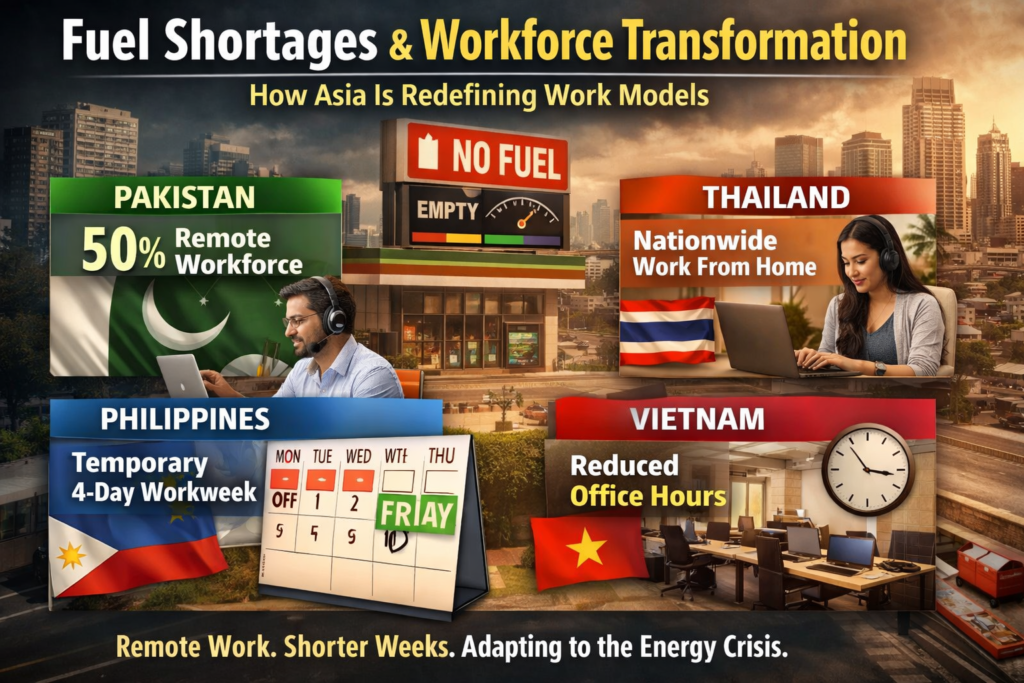
What began as an emergency energy measure has rapidly evolved into something far more consequential: a forced but potentially permanent transformation of workforce models across Asia. Countries that once resisted flexible work are now mandating it. Businesses that once dismissed remote operations are now running on them. And workers who had never considered a four-day week are suddenly living one.
This report examines how four key Asian economies — Pakistan, Thailand, the Philippines, and Vietnam — are responding to the energy crisis through workforce flexibility, and what these changes mean for the broader future of work in the region.
$100+Crude oil per barrel
March 2026
400MBarrels released by IEA
from emergency reserves
<20Days of oil reserves
remaining in Vietnam
95Days of energy reserves
left in Thailand
The Crisis Behind the Transformation
The U.S.-Iran conflict that began on February 28, 2026 rapidly escalated into a global energy emergency. The Strait of Hormuz, the narrow waterway connecting the Persian Gulf to the Arabian Sea, was effectively closed to maritime traffic — cutting off oil flows that much of Asia depends on. Japan sources approximately 90% of its oil from the Middle East; South Korea, around 70%.
By March 9, oil prices had surpassed $100 a barrel — the first time since Russia’s invasion of Ukraine in 2022. Analysts at Wood Mackenzie warned that $200 per barrel was not beyond the realm of possibility. The International Energy Agency convened its 32 member countries and executed what it called its largest-ever emergency oil reserve release: 400 million barrels — still deemed insufficient to fully stabilize global supply.
For Asia’s rapidly developing economies, the impact was immediate and visceral. Fuel stations across Manila displayed “Out of Stock” signs. Gas queues formed in Hanoi. The gig economy faltered as delivery platforms saw rising operating costs pass directly to their most vulnerable workers.
The energy crunch is not merely an economic event — it is a stress test for every assumption we made about how work must be organized.— HIB Recruitment Services Analysis, April 2026
Into this pressure cooker, governments across the region have reached for a tool they first tested during the COVID-19 pandemic: the flexible work mandate. But this time, the driver is not a virus — it is fuel. And the solutions being deployed are sharper, more structured, and in many cases, more ambitious than anything we saw in 2020.
Country-by-Country: How Asia Is Responding
Each nation’s response reflects its own governance style, energy dependency, and workforce infrastructure. But a clear regional pattern has emerged: compress the workweek, shift work home, and reduce the fuel burned in commuting.
South Asia
🇵🇰 Pakistan
4-Day Government Workweek + 50% WFH Mandate
Prime Minister Shehbaz Sharif announced a four-day workweek for all government offices, making Pakistan one of the first nations in the region to institute a government-wide compressed schedule as an energy conservation strategy. In addition, public and private organizations — with exemptions for agriculture, industry, and essential services — have been directed to ensure that at least 50% of their workforce operates from home at any given time. Schools were also closed as part of the broader austerity drive. Pakistan’s response is notable for its scope: it is not limited to the civil service but extends into the private sector through a direct government directive, signaling how seriously Islamabad views the energy threat to economic stability.
Southeast Asia
🇹🇭 Thailand
Full WFH for Civil Servants + Energy Austerity Code
Thailand moved swiftly, ordering civil servants to work from home for the full duration of the crisis on March 10, 2026. But Bangkok went further than most with its energy-saving operational code: government buildings raised air-conditioning temperatures to 27°C, employees were directed to take stairs rather than lifts, and formal dress codes were relaxed so workers could manage the heat comfortably. With approximately 95 days of energy reserves remaining at the time of writing, Thailand’s approach blends WFH mandates with in-office conservation protocols — a dual-track strategy that acknowledges not all roles can be performed remotely. The country is also promoting biodiesel and benzene as fuel alternatives, and has frozen cooking gas prices until May 2026 to ease household pressure.
Southeast Asia
🇵🇭 Philippines
4-Day Workweek + National Energy Emergency Declared
The Philippines made history by becoming the first country in the world to declare a state of national energy emergency in response to the crisis. President Ferdinand Romualdez Marcos ordered the implementation of a four-day workweek in certain executive branch offices beginning March 6 — four days before Thailand and Vietnam followed suit. Officials have been directed to limit travel strictly to essential functions, with virtual meetings replacing in-person engagements wherever possible. The government is also offering subsidies to public transport operators to ease the immediate burden on commuters and gig economy workers. Manila’s decisive and early action sets the Philippines apart as a regional leader in crisis-driven workforce restructuring.
Southeast Asia
🇻🇳 Vietnam
Employer-Led WFH Guidance + Import Tariff Review
Vietnam faces perhaps the most acute supply pressure of the four nations profiled here. With oil reserves estimated at less than 20 days, the Ministry of Industry and Trade issued an urgent call on March 10, urging all employers to permit remote work wherever operationally feasible, specifically to reduce transportation fuel consumption at the national level. Unlike Pakistan’s directive, Vietnam’s approach frames WFH as an employer obligation rather than a top-down mandate — reflecting the country’s preference for guided market responses. Hanoi is also reviewing tariffs on fuel imports, exploring whether removing trade barriers can soften the supply shock. Vietnam’s position as a major manufacturing hub makes its energy vulnerability especially significant for regional supply chains.
Regional Patterns: What the Data Tells Us
The Compressed Workweek as Policy Tool
Perhaps the most striking commonality across the region is the speed with which the four-day workweek — long debated in productivity circles as a progressive workplace experiment — has been adopted as emergency energy policy. Pakistan and the Philippines both implemented it within the first two weeks of the crisis. What took Iceland years of trials and Microsoft Japan a single experiment has taken these governments a press conference.
The logic is straightforward: a fifth day of commuting eliminated is a fifth of weekly transportation fuel demand erased — at least in the public sector. But the downstream effects are already proving complex. When government offices close on Fridays, private sector partners, citizens accessing public services, and supply chains that depend on government clearances must all adapt simultaneously.
Remote Work: From Privilege to National Strategy
Before this crisis, remote work in most of South and Southeast Asia remained the preserve of the knowledge economy — tech firms, multinational subsidiaries, and white-collar service providers. Factory workers, retail employees, and the vast informal sector had no such option. The energy crisis has exposed this structural inequality in sharp relief.
Vietnam’s and Thailand’s WFH guidance, while necessary, can realistically only reach an estimated 20–30% of their total workforce — those in roles that can be digitally performed. The remaining majority, including manufacturing workers, service industry employees, and the enormous gig economy workforce, remain fully exposed to rising fuel costs and commuting pressures, with no equivalent policy protection.
Virtual Operations and the Digital Infrastructure Test
The crisis is also functioning as an unplanned but revealing audit of Asia’s digital infrastructure. Countries that invested heavily in broadband penetration, cloud adoption, and digital government services during and after the pandemic are discovering that their WFH mandates are executable. Those with patchy connectivity in secondary cities and rural areas are finding that the mandates are aspirational at best.
The Philippines, despite being among the most aggressive in policy terms, faces consistent challenges with home internet reliability outside Metro Manila. Pakistan’s directive for 50% home working applies to a workforce where home connectivity and power stability are not uniformly available. The gap between policy ambition and digital infrastructure readiness will shape how effective these mandates ultimately prove to be.
The energy crisis has done in two weeks what workplace innovation advocates could not achieve in two decades: it has made flexible work a matter of national policy, not corporate preference.— Workforce Intelligence, HIB Recruitment Services
Workforce Implications: What This Means for Employers and Talent
For Employers: Accelerated Structural Change
Businesses operating in these markets are navigating a dual pressure: government mandates that require a percentage of their workforce to operate remotely, and rising operational costs from energy prices that threaten margins. The companies that will emerge strongest are those that treat this moment not as a disruption to be endured, but as a transformation to be designed.
Organizations that establish robust remote work infrastructure now — project management tools, async communication protocols, digital onboarding pipelines — will retain talent and maintain productivity through the crisis and beyond. Those that attempt to resist the shift will face both regulatory pressure and workforce attrition, as employees who discover the viability of remote work will be reluctant to return to five-day, full-time office models when the crisis eventually resolves.
For Talent: A Shift in What Workers Will Accept
On the employee side, the crisis is recalibrating expectations — permanently. Workers in Pakistan, Thailand, the Philippines, and Vietnam who are experiencing government-mandated flexible arrangements for the first time are, in many cases, discovering that their productivity does not diminish outside the office. That discovery is not forgotten when mandates are lifted.
Post-crisis, talent competition in the region will increasingly be shaped by flexibility. Employers who can credibly offer hybrid and remote arrangements will access a broader talent pool; those who cannot will compete for a shrinking share of workers willing to accept rigid, office-first arrangements.
For the Gig Economy: Exposure Without Protection
The energy crisis has hit gig workers with particular severity. In India, the Gig Workers Association reported that rising fuel prices were threatening delivery workers’ livelihoods, with restaurants closing due to LPG shortages and platforms potentially penalizing workers whose performance suffers as a result of disruptions they cannot control. The Philippines’ transport subsidies represent one of the few direct policy interventions aimed at this segment. Across the region, the crisis is making visible what was already true: gig workers are the most economically vulnerable members of the flexible workforce, with the fewest protections and the least capacity to absorb external shocks.
Beyond the Crisis: Is This a Permanent Reset?
The question every business leader, HR professional, and policymaker in the region is quietly asking is: when the fuel supply stabilizes and prices retreat, will the workforce go back to the way it was?
The evidence from the COVID-19 pandemic suggests it will not — at least not entirely. The remote work experiment forced by the pandemic left a permanent residue of behavioral change, policy reform, and workforce expectation that companies are still navigating years later. The energy crisis of 2026 may prove similarly transformative, for several reasons.
First, governments that have implemented four-day workweeks and WFH mandates will face significant political resistance if they attempt to simply reverse these policies when oil prices normalize. Workers, once extended flexibility, rarely cede it willingly.
Second, businesses that have invested in remote work infrastructure will have economic incentives to maintain it — reduced office footprint, lower utilities, and access to geographically distributed talent pools all represent ongoing cost and capability advantages.
Third, and perhaps most importantly, the crisis has demonstrated that the energy cost of commuting is a real, quantifiable economic variable. Countries with ambitious net-zero targets will note that their WFH mandates also delivered measurable carbon and fuel savings. Environmental policy and workforce policy, previously siloed, are beginning to converge.
Asia’s fuel shortage may have begun as a crisis. But it is accelerating a structural shift in how work is organized — one that was already underway, and that will now move faster than anyone predicted.
✦ ✦ ✦
Partner With Us · HIB Recruitment Services
Your Workforce Strategy
Needs to Evolve. We Can Help.
The energy crisis is rewriting the rules of talent — faster than most organizations can respond. Whether you need to build a remote-ready team, hire across borders, restructure your workforce for a compressed workweek, or source flexible talent that can operate in a digitally distributed environment, HIB Recruitment Services is your strategic partner for what comes next.
We specialize in connecting organizations across South and Southeast Asia with the skilled, adaptable, and globally aware professionals that a transformed work landscape demands. From executive placements to project-based remote talent, we match your needs with precision, speed, and care. “Connecting Talent. Building Futures.”