
HIB RECRUITMENT SERVICES | Connecting Talent. Building Futures.
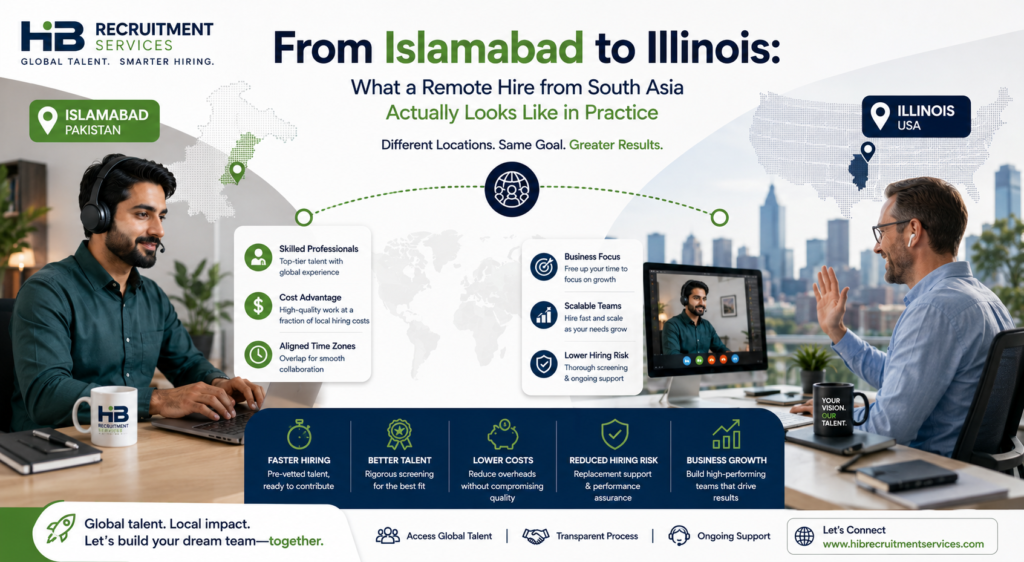
There’s a question that comes up in almost every first conversation we have with a US or UK business owner considering remote hiring for the first time:
| “This sounds good in theory — but what does it actually look like? How does the hiring process work? Who handles the vetting? What happens at onboarding? And honestly… will it really work for my company?” |
It’s a fair question. And it deserves a real answer — not a sales pitch.
Today, we’ll walk you through exactly what the remote hiring process looks like when you work with HIB Recruitment Services. From the initial brief through to a candidate’s first 90 days on the job, we’ll show you what happens at every stage — using a realistic, composite example based on the kinds of placements we make every day.
By the end, you’ll know whether this is the right move for your business in 2026.
Why US and UK Companies Are Turning to South Asia for Remote Talent in 2026
The global remote work market didn’t just survive the post-pandemic correction — it matured. By 2026, remote hiring has moved from a reactive workaround to a deliberate growth strategy for thousands of businesses across the US and UK.
The numbers make the case clearly:
- The average software engineer salary in the US now ranges from $120,000 to $180,000 per year, not including benefits, payroll taxes, or office overhead.
- Equivalent-calibre engineers and technical professionals in Pakistan, the Philippines, Thailand, and Vietnam can be hired at 40–70% lower total cost — without any compromise on output quality.
- LinkedIn’s 2025 Global Talent Trends report found that 72% of hiring managers who had placed remote talent from South or Southeast Asia rated the experience as “meeting or exceeding expectations.”
- Pakistan alone produces over 25,000 STEM graduates annually, many of whom have trained on the same technology stacks and frameworks used by US and UK firms.
The talent is world-class. The question is simply whether you have the right partner to find it, vet it, and place it effectively.
The HIB Recruitment Process: A Step-by-Step Walkthrough
Let’s follow a real-world scenario. A mid-sized technology company based in Chicago — we’ll call them Meridian Tech — came to HIB Recruitment Services in early 2026 needing a full-stack developer with Python and React experience. Their internal team was stretched, their US-based hiring pipeline had stalled, and their CEO had a quarterly target to meet.
Here is exactly what happened next.
Step 1: The Discovery Brief (Week 1)
Before HIB posts a single job or contacts a single candidate, we sit down — virtually — with the hiring manager to understand three things:
- The role: technical requirements, seniority level, tools, and stack.
- The team: culture, communication style, working hours, and reporting structure.
- The outcome: what does success look like at 30, 60, and 90 days?
For Meridian Tech, this session took 45 minutes. It gave HIB everything needed to build a precise candidate profile — not just a job description, but a full picture of the person and the environment they’d be working in.
Step 2: Candidate Sourcing and Pre-Screening (Weeks 1–2)
HIB’s talent network spans Pakistan, the Philippines, Thailand, and Vietnam — markets we have worked in for years and understand deeply. Sourcing isn’t done through a single job board. It’s done through a combination of:
- Active database outreach to pre-qualified professionals
- Targeted LinkedIn searches with role-specific filters
- Referrals from our existing placement network
- Selective job postings on regional and global platforms
Every candidate who expresses interest goes through HIB’s multi-stage pre-screening process before a client ever sees their name. This includes a CV review, a written communication assessment, a technical skills evaluation, and a structured video interview conducted by our team.
For Meridian Tech, HIB reviewed 34 candidates and shortlisted 4 for client review.
Step 3: Client Review and Selection (Week 2–3)
The shortlisted candidates were presented to Meridian Tech with full candidate packs — including role-matched summaries, pre-screening interview notes, and our own recommendation rationale for each.
Meridian Tech conducted one interview round with each of the four candidates. Within five days, they selected their hire: a full-stack developer based in Lahore, Pakistan, with six years of experience, strong English communication, and a portfolio that included two previous US client projects.
Step 4: Offer, Compliance, and Onboarding Preparation (Week 3–4)
This is the stage where many companies going it alone hit friction. Contracts, time zones, payment structures, and compliance requirements for cross-border employment can be complex. HIB handles this as part of the placement process — advising on contractor versus employment arrangements, standard remote working agreements, and communication protocols that set both parties up for success.
We also provide a structured onboarding checklist to the hiring company: a practical guide covering communication norms, tool access, expectation-setting for the first week, and a suggested 30-day check-in framework.
Step 5: The First 90 Days
Meridian Tech’s new hire started on a Monday. By Friday of week one, he had completed onboarding, submitted his first pull request, and joined the team’s weekly stand-up.
Here’s what the first 90 days looked like in practice:
- Onboarding, codebase familiarisation, first feature contribution. Zero communication issues. Daily async updates via Slack. Days 1–30:
- Independent delivery of a medium-complexity feature. Proactive with questions. Flagged a legacy code issue the existing team had missed. Days 31–60:
- Assigned as lead developer on a new module. Meridian Tech’s CTO described the hire as “already one of our most reliable team members.” Days 61–90:
| “We were sceptical going in. We’d heard mixed things about remote hiring. HIB made the process straightforward, and the candidate exceeded every expectation. We’re already discussing our next placement.” — CTO, Meridian Tech (composite client example) |
The Objections We Hear — and the Reality
“Time zones will be a problem.”
Pakistan is UTC+5, the Philippines UTC+8. For US companies (EST/CST), this creates a meaningful overlap window in the morning. Many of our clients structure their remote hires on a flex schedule with core overlap hours — typically 9am–1pm client time — which covers stand-ups, code reviews, and collaborative sessions. The rest of the day runs async. In practice, this actually increases documentation quality and reduces unnecessary meetings.
“I can’t verify the quality of overseas candidates.”
You don’t have to. That’s what HIB is for. Every candidate we present has been put through a documented vetting process. You receive pre-screening notes, communication samples, and our own assessment before you spend a single hour of your time. If the candidate doesn’t meet the brief, we go back to the pipeline.
“What if it doesn’t work out?”
It’s a valid concern for any hire, anywhere in the world. HIB provides post-placement support and maintains communication with both client and candidate during the first 90 days. Our placement satisfaction rate speaks for itself — and we build long-term relationships with clients, not one-off transactions.
What Makes South Asian Talent Particularly Strong in 2026?
The remote talent market in South Asia has undergone a significant maturation over the past five years. Professionals entering the market in 2026 have grown up with remote work as the default, not the exception. They are:
- Fluent in the communication tools and async workflows that distributed teams rely on
- Trained on internationally recognised curricula, with growing numbers holding certifications from Google, AWS, Microsoft, and Coursera
- Experienced in working across time zones, often having trained under or alongside Western colleagues
- Motivated by long-term stability with international clients — meaning lower turnover than many US and UK local hires
Pakistan in particular has seen a 40% increase in IT sector exports over the past three years, with Karachi, Lahore, and Islamabad emerging as genuine tech talent hubs. The Philippines continues to be a world-leading source of finance, operations, and customer success professionals. Vietnam and Thailand are producing strong engineering and digital marketing talent at increasing rates.
These are not emerging markets hedging their bets. These are mature talent ecosystems — and HIB Recruitment Services has been operating inside them for years.
Is Remote Hiring from South Asia Right for Your Business?
It is likely the right move if:
- You are hiring for roles in tech, finance, marketing, operations, or customer success
- Your team already works in a hybrid or async-first environment
- You are open to a structured onboarding process and clear communication frameworks
- You want to scale your team in 2026 without doubling your headcount cost
It may require more preparation if your role demands daily in-person presence, highly localised market knowledge, or regulatory requirements specific to your jurisdiction. In those cases, HIB will tell you honestly — and help you find the right solution.
The Bottom Line
The story of Islamabad to Illinois isn’t about taking a chance on an unknown. It’s about accessing world-class talent through a process that is structured, transparent, and built around your business outcomes.
The companies growing fastest in 2026 are not the ones with the biggest local hiring budgets. They are the ones asking smarter questions about where the best people are — and then going to find them.
HIB Recruitment Services exists to make that journey straightforward, low-risk, and high-return.
| Ready to Make Your First Global Hire? If you’re planning to grow your team this quarter, let’s have a conversation. HIB Recruitment Services works with US and UK companies to source, screen, and place pre-qualified remote professionals from South and Southeast Asia. No fluff. No wasted time. Just the right hire. Book a Free Discovery Call with HIB Recruitment Services hibrecruitmentservices.com | contact@hibrecruitmentservices.com “Connecting Talent. Building Futures.” |


Leave a Reply