
What is the “Big Stay” economy and how should employers hire in 2026? HIB Recruitment Services breaks down the structural workforce shift and what to do next.
What does “low-hire, low-fire” actually mean?
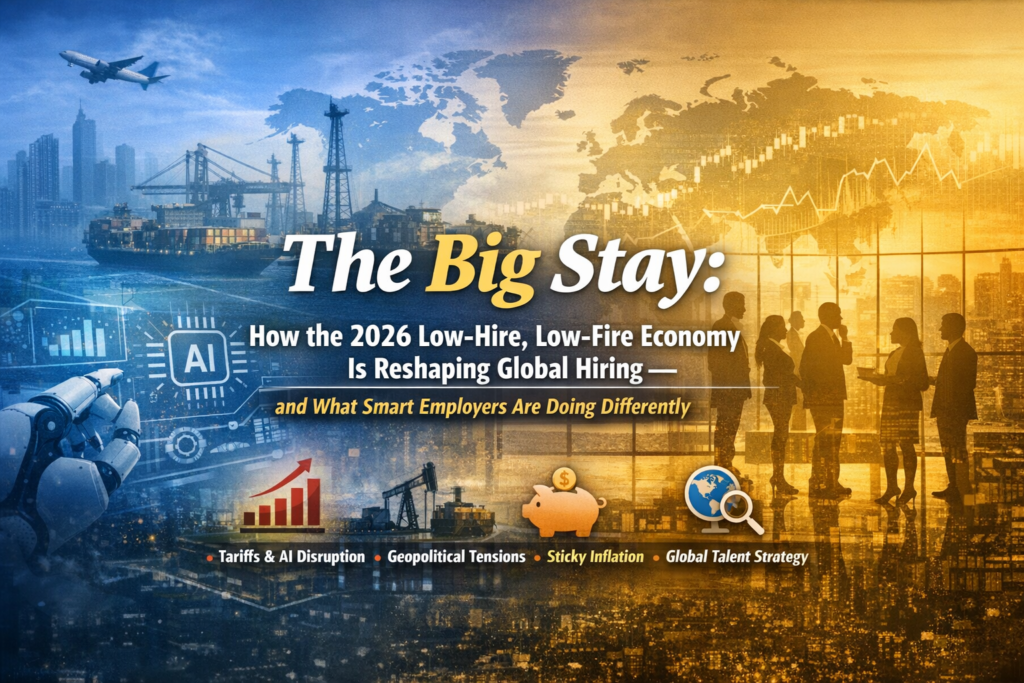
The global workforce in 2026 has entered an unusual phase—often described as a low-hire, low-fire economy 2026. In simple terms, companies are holding onto their existing employees while significantly slowing down new hiring.
It’s not a hiring freeze in the traditional sense. Nor is it a wave of layoffs. Instead, it’s something in between—a cautious pause.
Key characteristics of the low-hire, low-fire economy
- Companies retain current employees to avoid rehiring costs later
- Hiring pipelines slow down dramatically
- Job openings exist but take longer to fill
- Employers become highly selective
- Workforce mobility declines
This phenomenon is also being referred to as the “Big Stay economy”, where employees choose stability over risk, and employers mirror that behavior.
Why it matters globally
This isn’t just a localized trend. From North America to Asia and emerging markets, businesses are responding to uncertainty by preserving their workforce rather than expanding it.
According to global labor insights from organizations like the ILO and major financial institutions, this trend is expected to persist through 2026 and beyond.
5 forces driving the 2026 structural workforce shift
The structural workforce shift 2026 didn’t happen overnight. It’s the result of multiple global forces converging at once.
1. Trade tensions and tariffs
Rising tariffs and protectionist policies have increased the cost of doing business globally. Companies are hesitant to expand headcount when margins are under pressure.
2. AI replacing jobs in 2026 — which roles?
Artificial intelligence is no longer experimental—it’s operational.
Roles most affected:
- Entry-level administrative jobs
- Customer support roles
- Basic data processing
- Junior marketing functions
Meanwhile, AI is augmenting, not replacing:
- Strategic HR roles
- Engineering and tech leadership
- Creative and decision-making roles
This shift makes companies cautious about hiring for roles that may soon be automated.
3. Geopolitical instability
Global tensions—especially around key trade routes and energy supply—have made business forecasting difficult. Employers are choosing stability over expansion.
4. Sticky inflation
Even as inflation cools slightly, it remains unpredictable. Businesses are controlling costs, and payroll is the largest expense.
5. Immigration policy tightening
Stricter immigration rules in many developed economies have reduced access to foreign talent, forcing companies to rethink hiring strategies.
The two-speed workforce — who’s winning, who’s stalling
The global hiring trends 2026 reveal a stark divide.
High-growth sectors (winning)
- Healthcare and social assistance
- Technology and AI-related roles
- Renewable energy
- Cybersecurity
These sectors continue to hire due to structural demand.
Stagnating sectors (stalling)
- Retail
- Hospitality
- Manufacturing (in some regions)
- Administrative support
These industries are experiencing minimal job growth.
Global workforce reality
- Over 2.1 billion workers remain in informal employment
- Youth unemployment (NEET rate) hovers around 20% globally
This creates a paradox: jobs exist, but access to them is uneven.
What this means for employers trying to hire in 2026
The low-hire, low-fire economy 2026 has shifted power dynamics.
- Employers now have more leverage
- Time-to-hire has increased
- Candidate pools are larger—but not always qualified
Hiring freeze vs hiring slow
| Factor | Hiring Freeze | Hiring Slow |
|---|---|---|
| Hiring activity | Stopped | Reduced |
| Candidate flow | Minimal | Moderate |
| Decision speed | Frozen | Delayed |
| Employer strategy | Survival | Optimization |
Most companies today fall into the “hiring slow” category—not frozen, just cautious.
👉 Bonus: Get the free 2026 Hiring Playbook included in this article and start building your strategy today.
6 hiring strategies that work in a low-hire, low-fire market
If hiring is slower, it must also be smarter. Here’s how leading companies are adapting.
1. Global talent sourcing
Expanding beyond local markets allows access to:
- Lower-cost talent pools
- Specialized skill sets
- Faster hiring cycles
This is especially critical when domestic hiring is stagnant.
2. Fractional HR and flexible hiring
Instead of full-time hires, companies are using:
- Contract roles
- Project-based hiring
- Fractional executives
This reduces risk while maintaining productivity.
3. Skills-first hiring approach
Degrees are becoming less important than demonstrable skills.
Focus areas:
- Portfolio-based hiring
- Skill assessments
- Real-world problem solving
4. Remote-first roles
Remote work isn’t just a perk anymore—it’s a strategy.
Benefits:
- Access to global talent
- Reduced overhead
- Increased flexibility
5. AI-augmented recruitment
Recruitment itself is being optimized using AI:
- Resume screening automation
- Predictive hiring analytics
- Candidate matching algorithms
6. Employer branding investment
In a slow hiring market, reputation matters more than ever.
Companies must:
- Build trust
- Showcase culture
- Communicate stability
The case for global talent in a frozen domestic market
As domestic hiring slows, global talent becomes the competitive edge.
Companies that adapt early will:
- Secure top talent before competitors
- Build resilient, distributed teams
- Reduce dependency on local economic cycles
👉 Internal Insight: This aligns directly with HIB’s approach to cross-border hiring and workforce resilience strategies, especially in regions affected by operational disruptions like fuel shortages.
🌍 Regional Hiring Disparities (2026 Snapshot)
| Region | Hiring Trend | Key Challenge | Opportunity |
|---|---|---|---|
| United States | Slow hiring | High costs | AI adoption |
| Europe | Cautious | Regulation | Skilled migration |
| Asia | Growing | Talent mismatch | Remote workforce |
| Emerging Markets | Volatile | Informality | Cost advantage |
❓ Frequently Asked Questions (FAQs)
1. What is the Big Stay economy?
The Big Stay economy refers to a labor market where employees remain in their current jobs while employers reduce hiring activity, creating low workforce mobility.
2. Is 2026 a good time to hire?
Yes—but only with the right strategy. Employers who adopt global and flexible hiring models can gain a competitive advantage.
3. Which jobs are safe in 2026?
Roles that are less likely to be automated include:
- Healthcare professionals
- AI specialists
- Strategic leadership roles
- Skilled trades
4. How is AI replacing jobs in 2026?
AI is replacing repetitive and rule-based roles while enhancing jobs that require creativity, judgment, and human interaction.
5. What is the difference between hiring freeze and hiring slow?
A hiring freeze stops recruitment entirely, while hiring slow means companies continue hiring but at a reduced pace and with stricter criteria.
6. How to hire during economic uncertainty?
- Focus on skills over credentials
- Use global talent pools
- Adopt flexible hiring models
- Invest in employer branding
👉 Inside this article: A free downloadable hiring playbook to help you take action immediately.
Conclusion — Don’t wait for the thaw, build your pipeline now
The low-hire, low-fire economy 2026 isn’t a temporary pause—it’s a structural shift.
Companies that wait for hiring to “return to normal” will fall behind.
Instead, forward-thinking employers are:
- Building global pipelines
- Leveraging AI
- Rethinking workforce strategy
As interest rates stabilize and economic confidence returns, there will be a release of pent-up hiring demand. Those who prepare now will win first.
🚀 Ready to Adapt Your Hiring Strategy?
Don’t navigate the Big Stay alone.
Book a free consultation with HIB Recruitment Services and discover how to build a resilient, future-ready workforce in 2026 and beyond.
/

Leave a Reply